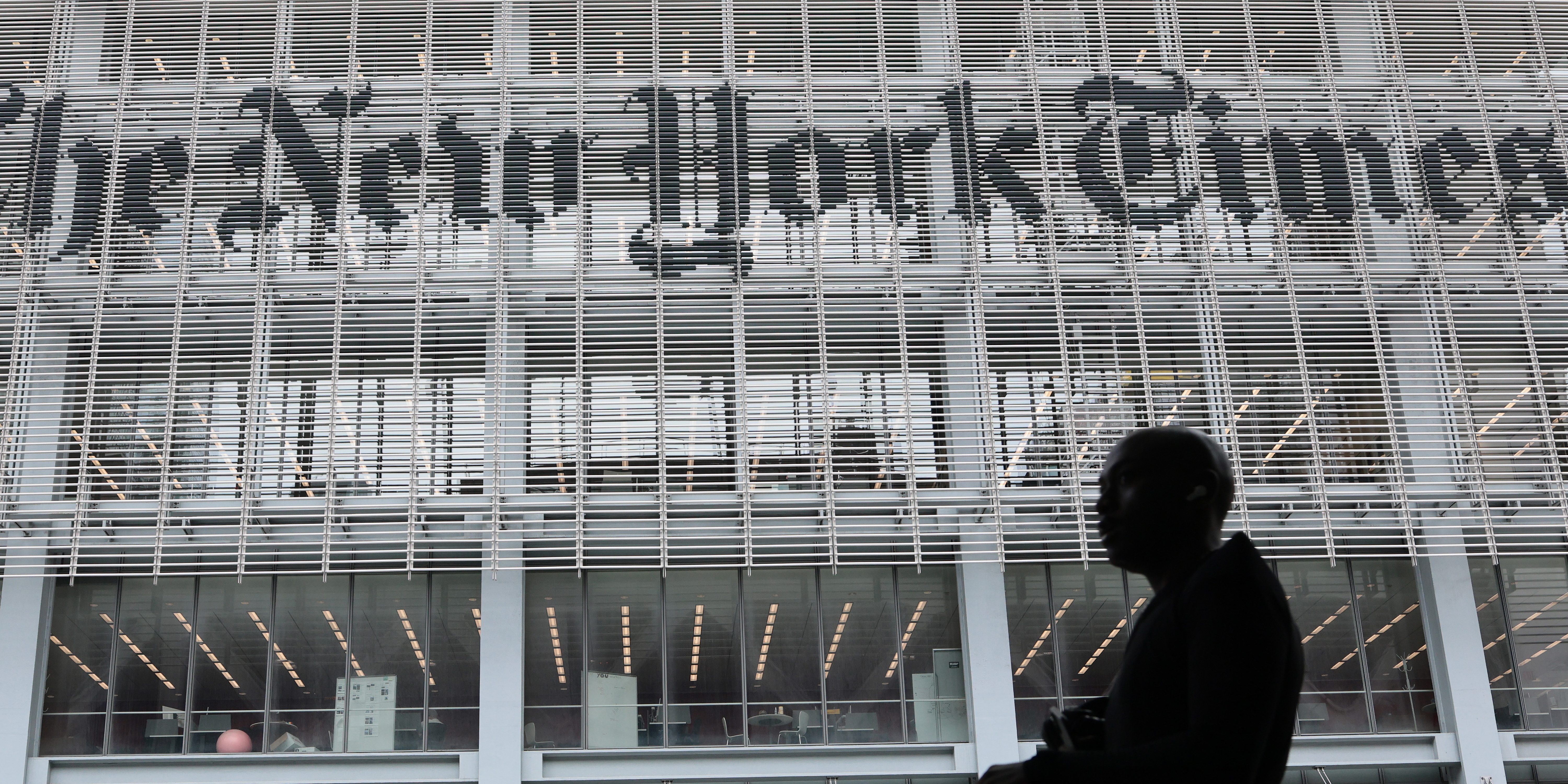
The Equal Employment Opportunity Commission, a key achievement of the Civil Rights Act of 1965 and the federal agency tasked with protecting American workers from employment discrimination, sued the New York Times on behalf of a white man claiming the company discriminated against him based on his race and sex.
The lawsuit is signed not just by the agency’s acting general counsel and deputy general counsel, but also Benjamin North, who The Intercept reported was hired earlier this year as assistant general counsel.

Related
EEOC Quietly Hired Lawyer Who Crusaded for Cases of Discrimination Against Men — Including His Own
North was suspended as a college student over a rape allegation in a case that he claimed violated his civil rights; he has consistently denied the charges. North went on to do work arguing that Title IX, which prohibits gender discrimination at federally funded institutions, has been used to discriminate against the rights of men.
North’s signature on the new lawsuit against the New York Times could mean he wrote it, said Chai Feldblum, a former EEOC chair.
Asked about North’s role, EEOC spokesperson Victor Chen referred The Intercept to the complaint.
The suit comes as part of President Donald Trump’s campaign against diversity, equity, and inclusion policies across the country, including his administration’s efforts to use the EEOC to these ends.
The new EEOC suit, filed Tuesday on behalf of an unnamed man whose identity New York Magazine speculated about, alleges that the employee was passed over for a position because he is a white man.
The claimant applied for a job as a deputy real estate editor in January 2025 but, the lawsuit claims, despite meeting all the requirements for the position, he didn’t get it because he “did not match the race and/or sex characteristics NYT sought to increase in its leadership.” Instead, the job went to a multiracial female candidate who the lawsuit alleges was not qualified.
“There is no actual evidence that he was more qualified than her.”
Feldblum, the former EEOC chair, was skeptical of the agency’s legal argument.
“There is no actual evidence that he was more qualified than her,” Feldblum said. Of the EEOC, she said, “They’re putting out their best facts in this complaint, and the facts are pathetic.”
Particularly for leadership positions, she pointed out, there are many aspects that go into deciding who is the most qualified candidate.
“Their assertion that she was less qualified than him is based on their view of the facts,” she said. “We’ll see what the facts actually say.”
In a statement, the New York Times said it has merit-based employment practices.
“The New York Times categorically rejects the politically motivated allegations brought by the Trump administration’s EEOC,” said Times spokesperson Danielle Rhoades Ha. “Throughout this process, the EEOC deviated from standard practices in highly unusual ways. The allegation centers on a single personnel decision for one of over 100 deputy positions across the newsroom, yet the EEOC’s filing makes sweeping claims that ignore the facts to fit a predetermined narrative.”
Diversity Without Discrimination
The EEOC’s lawsuit claims that the company has “engaged in unlawful employment practices” since at least October 2024 through its diversity, equity, and inclusion policies. It cites the company’s self-published diversity goals, including a 2021 document setting a goal for increasing Black and Latino leadership by 50 percent within four years.
The Times was making “employment decisions on the basis of race and sex to achieve its desired demographic goals,” the lawsuit alleges. “A necessary consequence of NYT’s intent to increase the percentage of non-White leaders would be a decrease in the percentage of White leaders.”
The assertion that the company has engaged in illegal racial and sex discrimination and is making employment decisions solely on those bases “is simply not borne out by the evidence,” Feldblum argued. The EEOC would instead have to have found evidence that hiring decisions were made expressly and intentionally based on such characteristics.

Related
Trump Administration Texted College Professors’ Personal Phones to Ask If They’re Jewish
Instead, the actions the New York Times took are “the most basic, acceptable, legal ways to try to increase diversity in a workplace,” Feldblum said. “There is literally nothing illegal in anything that the EEOC has detailed.”
The only place where the Times could have potentially run into legal trouble, she said, was when it was requiring diverse candidate pools for jobs. But if done carefully, she said, that can follow the law as well — for example, by expanding a pool of candidates without removing any qualified white or male ones.
“One can include diversity as an employer without discriminating against white people,” Feldblum said.
Kalpana Kotagal, the sole Democratic commissioner on the EEOC after Trump fired the others contra statute, said she voted against authorizing the lawsuit against the New York Times “because I disagree with the substance of the case and don’t believe it’s a good use of scarce agency resources.”
She added that “a commitment to diversity, equity, inclusion, and accessibility (DEIA), without more, is not evidence of discrimination.”
As a reporter at the Times told New York Magazine, “I’m sorry, there are plenty of white guys at the top of the New York Times. Not really something that’s holding you back.”
The complaint comes after EEOC Chair Andrea Lucas directly solicited complaints from white men alleging that they were discriminated against based on their race and/or sex. She has also instructed agency officials to focus on cases that are in line with her personal priorities, which include “rooting out unlawful DEI-motivated race and sex discrimination,” and cases claiming reverse racism have been “accelerated through the process,” the New York Times recently reported, even though staff are struggling to find complaints with merit.
Feldblum argued that the lawsuit is “quite an inappropriate use of EEOC resources.” The agency’s staffing is currently at its lowest level in decades, so any focus on a particular issue comes at the expense of others.
She said, “It is truly a sad day for anyone who cares about civil rights to see what the EEOC is spending its resources on today.”
The post Lawyer on EEOC’s New York Times Lawsuit Has History Battling Discrimination Against Men appeared first on The Intercept.


Comments (0)
No comments yet. Be the first to comment!